We suspected it,
but Booking.com tested it.
The best technical offer is not enough to sell. You need to influence the customer's decision. Discover how.
Share your observations and suggestions too!
Share your observations and suggestions too!
Our welcome gift: 7 ideas to make people say yes! To get them:
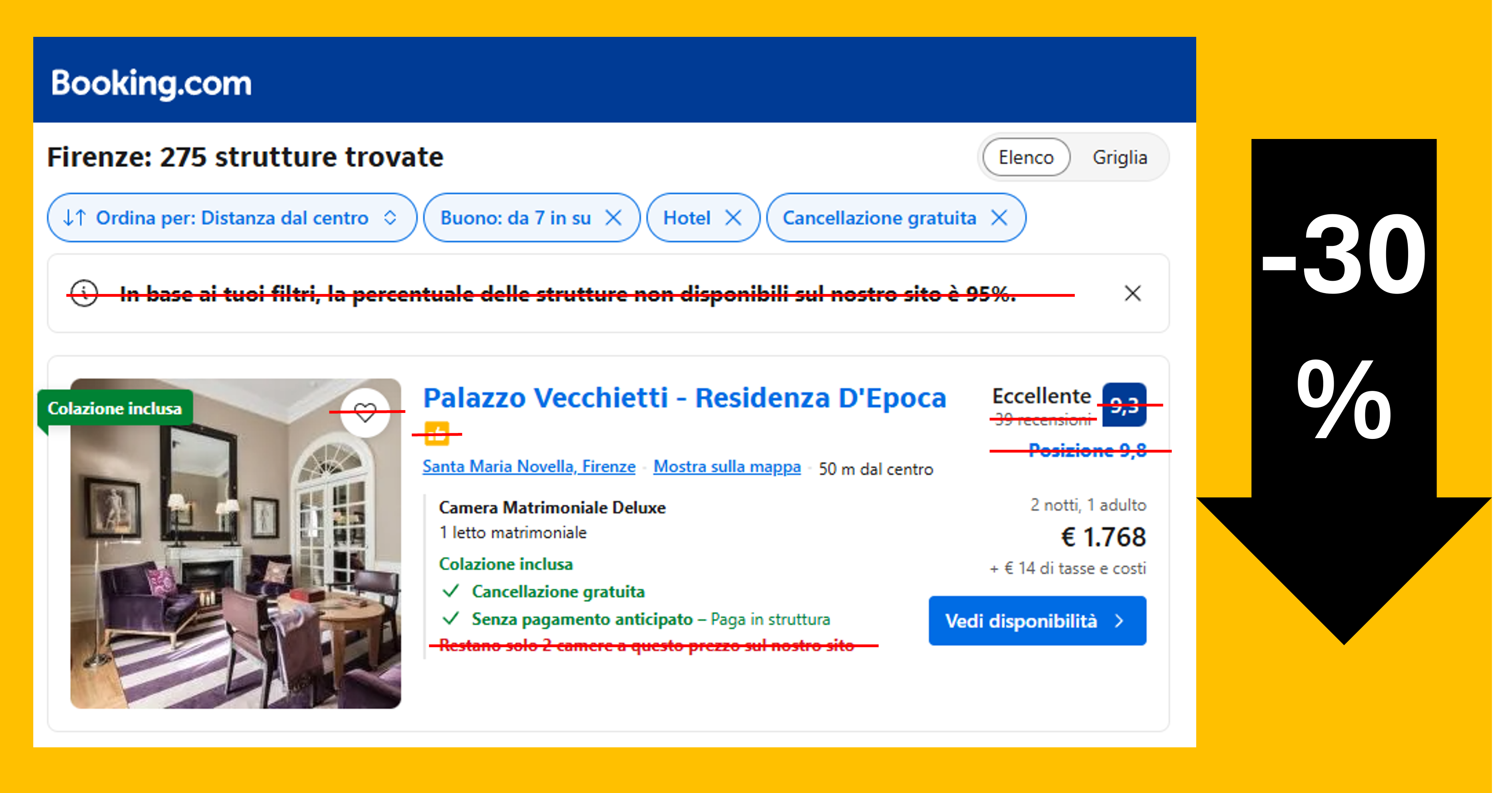
We suspected it, but Booking.com tested it.
They removed all persuasive communication from the website.
No reviews. No “only a few rooms left”. No little hearts…
…Meanwhile, sales dropped by 30%.
How long do you think it took them to put everything back?
Continue reading by accessing the portal!
Booking.com did not become the benchmark in the tourism industry by accident.
Its communication team — led by a psychologist — is constantly looking for effective ways to improve sales.
Like all of us.
Industrial sales are no exception — in fact, even more so.
Having a scientifically proven method that helps to:
Makes the difference, as demonstrated by companies such as Mercedes-Benz, Lilly, BAE Systems, SAP, and Bayer, who use Professor Cialdini’s 7 Universal Principles of Persuasion to sell better in B2B.
No reviews. No “rooms left”. No little hearts…
And possibly ones that cost little or nothing?
It’s not easy.
If you are a capable, experienced CEO,
you have probably already implemented all the best ideas —
and so have your competitors.
This is exactly the point where I found myself
a few years ago: SPIN Selling, Challenger Sales, Value Selling
and many other practices and methodologies were no longer enough.
And yet, just open any smartphone to see how
the largest online companies keep breaking sales records.
Like Booking.com
Booking.com keeps improving its results
because it has adopted a new sales model.
Alongside the traditional “Value” offer,
it has integrated the lessons of Behavioral Economics:
Every time you click on a website,
you are gently nudged toward a decision.
This website is no exception.
Online and offline, your behaviors are monitored, analyzed, and encouraged every day.
Most of the time, a small change creates huge results
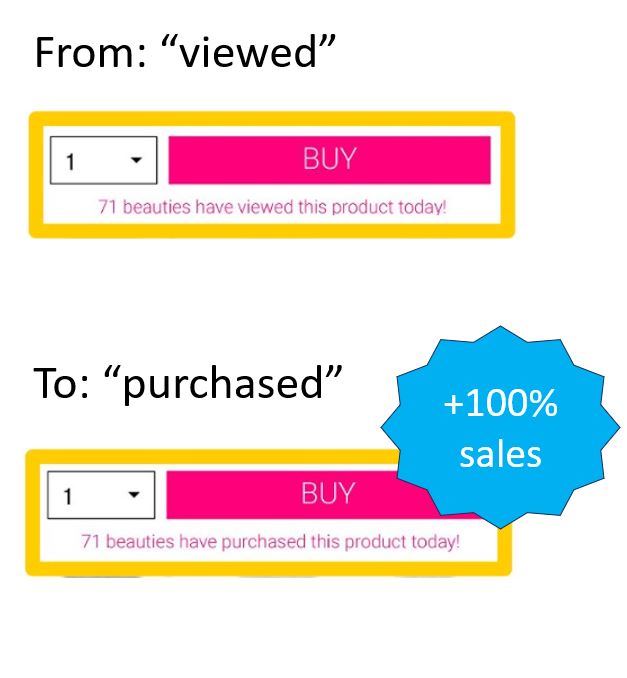
For example, by changing this sentence accompanying a product page in an e-commerce site from:
sales increased by 100%.
Same effort — completely different results.
Our brain made a different decision — based on a single word.
It did so without us even realizing it.
The reason is that we are Carbon, not Silicon.
The way we decide is far from rational:
It gets worse:
For example:
Today, people are overwhelmed by information and forced to make hundreds of decisions a day. Our brain has found a way to navigate this complexity by using shortcuts that help us decide automatically.
Even when we must make highly rational business decisions, we are ultimately influenced by these shortcuts — thinking patterns that originate in the way our biological brain works, in its evolutionary history from primates to Homo sapiens, in the survival strategies of the species.
If we do not learn to activate these shortcuts in the customer to guide the final decision, we expect the customer to interpret the value of our offer alone. And they will do so not based on rational value models, but by using a “random” shortcut — often the one most easily activated at that moment, not the one that benefits them most and almost never the one that guarantees us fair recognition.
I began to notice that Value Selling was no longer enough when, trying to help sales teams improve results with my background as a process engineer, data analyst, and AI expert, I could only get so far.
I then started exploring copywriting, design, communication, game theory — up to decision science and behavioral economics, where Cialdini is one of the pioneers.
When Cialdini offered the opportunity to become a member of the Cialdini Institute, I jumped aboard and discovered that the 7 principles were exactly what I was missing to help others decide.
Professor Cialdini’s “7 Principles of Persuasion” help us activate these shortcuts — to help others say yes.
And they do so with small adjustments like the one above: a different word, a word inversion, one additional piece of information… leading to Big Results. These are the small-BIGs I selected for you in my webinars, drawn from the original material of the Cialdini Institute.
There are far more than three.
They are based on over 40 years of scientific research. Warren Buffett, to cite one of its greatest admirers, publicly stated that Professor Cialdini’s book "Influence" is the book that helped him most in his business.
The bonus is Professor Cialdini’s high ethical standard: he uses his science to help others decide better — not to manipulate them.
Because among the ideas that can be immediately applied for results, there are certainly those who use shortcuts exclusively in their own interest, to the detriment of the customer.
The cases of Enron, Madoff, Ponzi, and years of Professor Cialdini’s studies have shown that wrongdoers benefit only in the short term. In the long run, they all regret it.
Not so those who use shortcuts to help customers decide. The results prove it.
Join Free the next Webinar on the "7 Principles of Persuasion":
By changing one word, the result doubles.
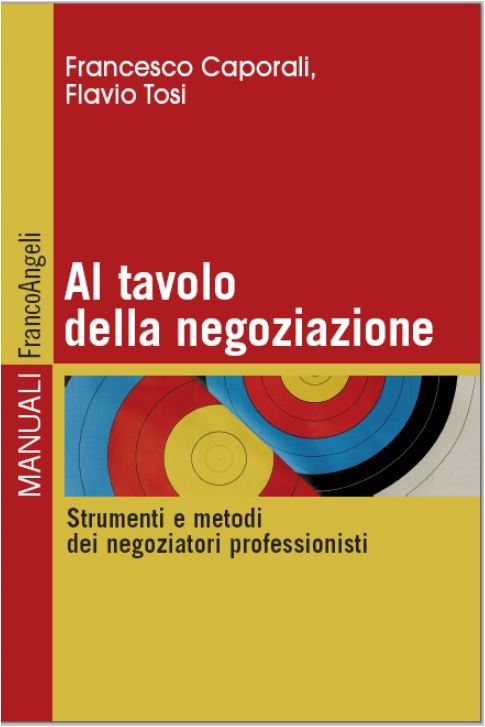
Strumenti e metodi dei negoziatori professionisti
Francesco Caporali - Flavio Tosi
Franco Angeli Editore
Valutazione 4,4 su 9 recensioni:
Per esperti e neofiti
Ottimo
Libro utile per la negoziazione business